
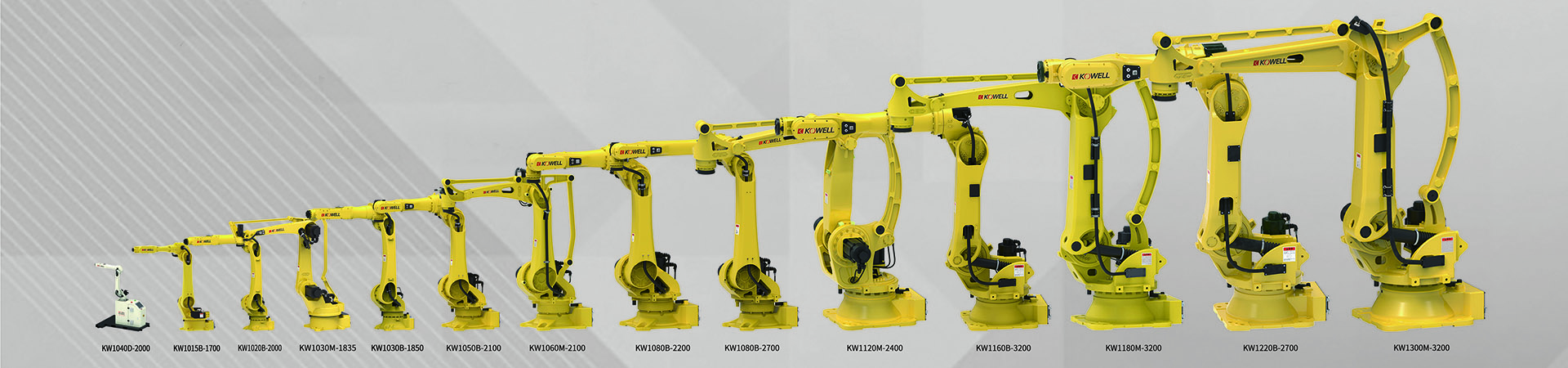
As skilled welders become harder to recruit and production orders become more fragmented, manufacturers are facing increasing pressure to maintain consistent welding quality. Manual welding depends heavily on operator experience and working conditions, while repetitive welding tasks can be affected by fatigue and variations in manual operation.
For manufacturers looking to introduce welding automation, the robot arm is one of the key execution units. Kowell Robot focuses on the mechanical structure, motion performance, and application flexibility of its welding robots to provide a more stable foundation for automated welding.
01 High-Rigidity Structure: A Stable Foundation for Welding Motion
Welding quality starts with stable and repeatable robot motion. During welding operations, the robot must follow a programmed trajectory while maintaining the required torch position and orientation.
Kowell welding robots use a reinforced high-rigidity mechanical structure to reduce deformation and vibration during robot movement. Combined with a high-precision servo drive system, the robot can maintain stable motion along the programmed path.
A rigid mechanical structure provides the physical foundation for repeatable positioning, particularly when the robot needs to perform continuous movements over complex working paths.
02 High Repeatability: Reproducing Welding Paths with Consistency
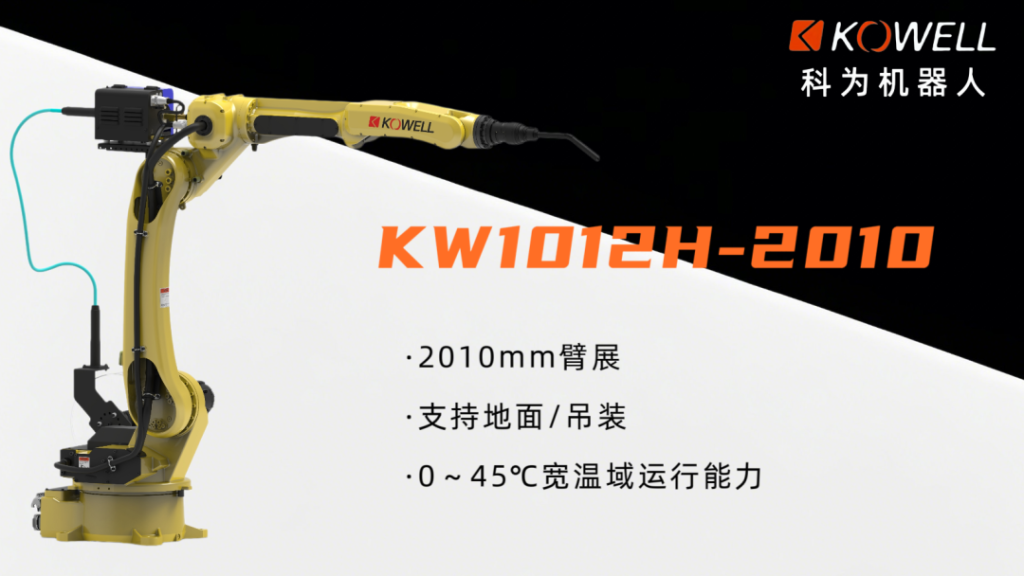
For automated welding, repeating the same welding path consistently is essential. Kowell KW1010H-1440 and KW1012H-2010 are designed for high-precision repeatable positioning, allowing programmed welding paths to be reproduced across repeated production cycles.
Whether the application involves spatial curves or longer linear welding paths, the robot can reproduce the programmed trajectory and torch movement with consistent positioning.
This repeatability helps reduce variations caused by manual operation and provides a more consistent foundation for welding process control. When combined with appropriate welding equipment, tooling, fixtures, and process parameters, it can contribute to more consistent weld quality and reduce unnecessary downstream finishing work.
03 Flexible Deployment: Adapting the Robot to Different Production Layouts
Welding automation does not always take place in a standardized production cell. Different workpieces, workshop layouts, and production processes can require different robot installation methods.
Kowell welding robots support floor-mounted and overhead installation, giving system integrators greater flexibility when designing the robot cell.
This allows the robot to be incorporated into existing production layouts with less need for major structural changes. Depending on the application, the robot can be deployed in compact workstations or used for larger structural components, helping manufacturers adapt automation to their existing production environment.
04 Multiple Welding Processes and Materials
Different industries require different welding processes and materials. A flexible welding robot should therefore be capable of working with different process configurations.
Kowell welding robot systems can be configured for common industrial welding processes such as MIG/MAG welding, TIG welding, and laser welding, depending on the application and system configuration.
They can be integrated into welding applications involving materials such as carbon steel and stainless steel, covering a range of manufacturing scenarios from automotive components to machinery and structural parts.
The robot itself provides the motion platform, while the welding power source, torch, positioner, tooling, and process equipment can be configured according to the specific application.
05 From Robot Hardware to Complete Welding Applications
The value of welding automation does not end with the robot installation. Successful deployment also depends on application analysis, process design, commissioning, and operator training.
Kowell can support welding projects based on factors such as workpiece geometry, production requirements, welding process, cycle time, and existing workshop conditions.
For suitable projects, the application team can assist with process planning, simulation, equipment installation, commissioning, and standardized operator training, helping customers move from robot selection to practical production more efficiently.
Building a More Stable Foundation for Welding Automation
As manufacturers face rising labor costs, fragmented production orders, and increasing requirements for consistent welding quality, welding automation is becoming more than a way to replace repetitive manual work.
The combination of high-rigidity mechanical structure, repeatable motion, flexible installation, and configurable welding processes provides the foundation for integrating robots into different manufacturing environments.
With models such as the KW1010H-1440 and KW1012H-2010, Kowell Robot continues to develop its robot bodies, control systems, and welding applications, helping manufacturers build welding automation solutions that are more stable, flexible, and suitable for real production needs.
Online Consultation
Hello, the current customer service is offline. You can leave your contact information and the staff will respond to you as soon as possible!