
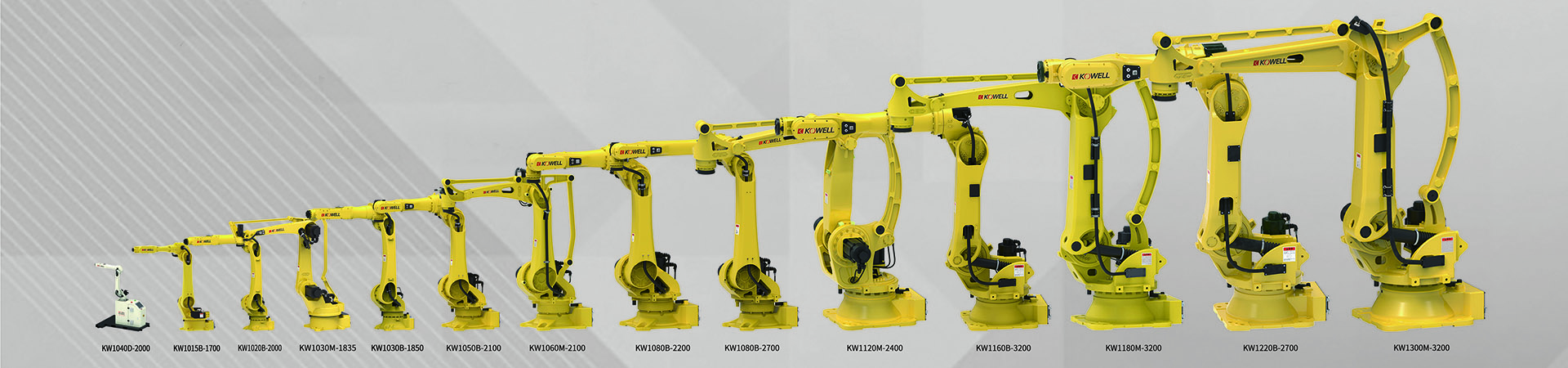
Palletizing has long faced a difficult balance between precision, ease of use, and flexibility. Higher precision often requires more sophisticated motion control and parameter settings. Supporting multiple products can increase setup and commissioning requirements, while collaborative operation also demands effective safety mechanisms without unnecessarily compromising productivity.
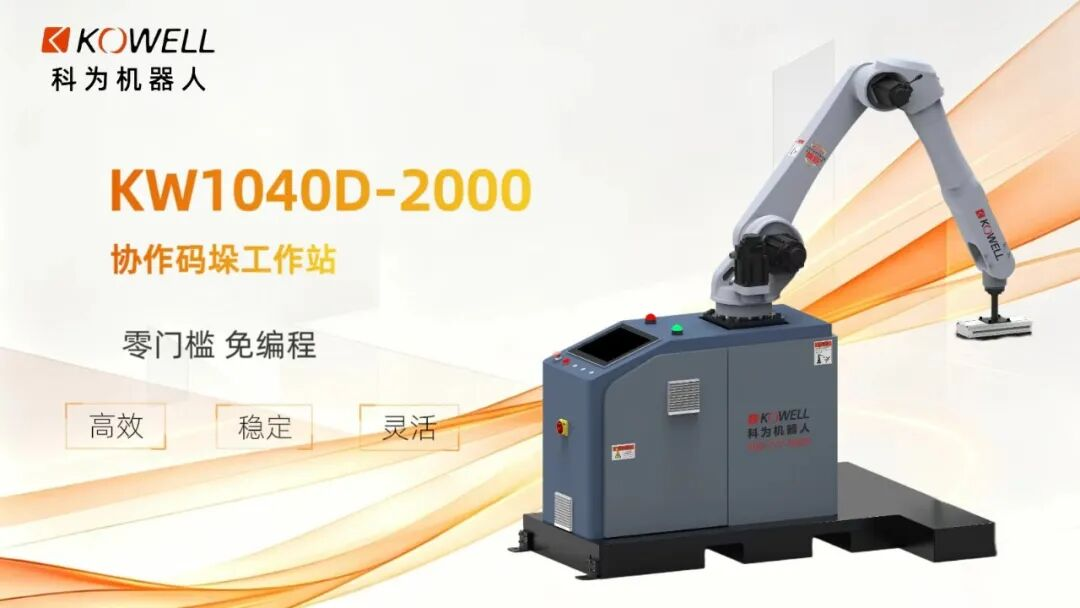
Kowell Robot addresses these challenges through coordinated development of the robot body, control system, and palletizing process. The KW1030D-1800 and KW1040D-2000 collaborative palletizing workstations integrate these technologies to improve motion stability, simplify operation, and support flexible production.
01 Motion Control: Improving Palletizing Stability Through Dynamic Parameter Matching
Palletizing may appear to be a repetitive pick-and-place task, but the robot must continuously adapt its motion to factors such as payload, working distance, and palletizing height. Under higher loads or at greater palletizing heights, acceleration, deceleration, and robot posture can directly affect positioning performance.
Kowell collaborative palletizing workstations use a dynamics-based motion model to match and optimize trajectory parameters according to different operating conditions. The robot can adjust its motion posture and speed profile to maintain stable movement during picking, transferring, and placing.
From gripping to final placement, the system combines smooth acceleration and deceleration, stable horizontal movement, and accurate positioning to improve stacking consistency and reduce irregular pallet patterns caused by motion fluctuations or positioning deviations.
This is an important difference between an integrated palletizing workstation and a simple combination of a robot arm and gripper: the robot's motion capability must work together with the palletizing process parameters to meet real production requirements.
02 Zero-Programming Control: Simplifying More Than 200 Parameters into 6 Basic Settings
If motion control determines how the robot performs its task, the operating system determines how easily operators can configure a new task.
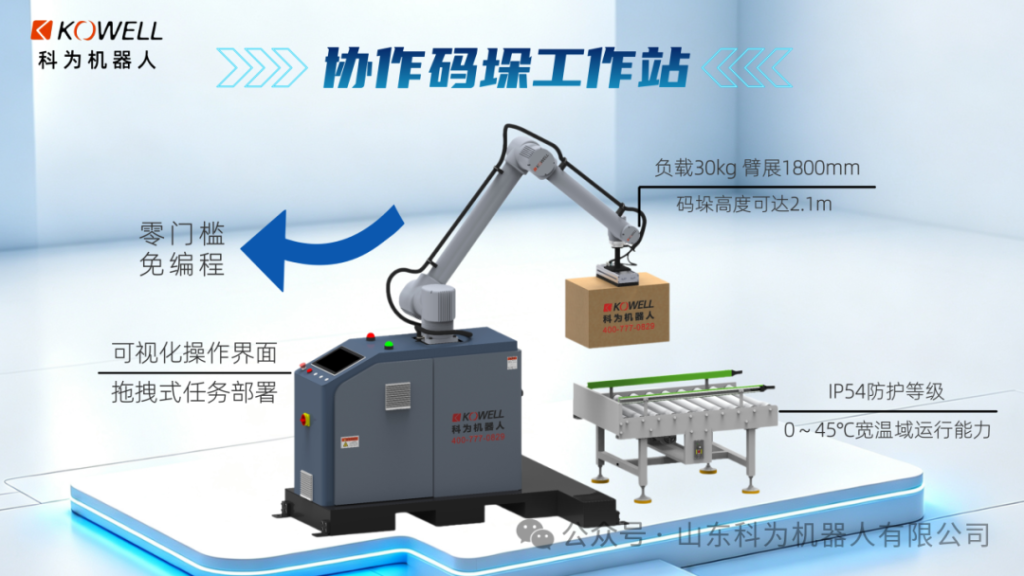
Kowell collaborative palletizing workstations feature a self-developed graphical intelligent control system with a 15.5-inch industrial touchscreen. Instead of requiring operators to work through hundreds of complex robot parameters, the system simplifies more than 200 parameters into 6 basic settings, reducing the complexity of on-site configuration and commissioning.
The system also supports 3D pallet pattern preview and modeling through touch gestures. Operators can visually configure product dimensions, arrangement patterns, and stacking layers without writing complex robot programs for basic palletizing tasks.
This zero-programming and graphical operating approach makes palletizing automation more accessible to production personnel and reduces dependence on specialized robot programming.
For multi-product production, different tasks can be configured for different products and recalled when required. Combined with the actual production setup, product changeovers can be completed within minutes, helping reduce downtime and repeated commissioning when production requirements change.
03 Safety Protection: 10-Level Collision Detection for Collaborative Operation
Collaborative palletizing is not simply about reducing robot speed. It requires safety functions to be built into the robot system itself.
Kowell collaborative palletizing workstations feature a 10-level collision detection system that monitors changes in external force during robot operation. When abnormal external force is detected, the robot can respond rapidly by reducing speed or stopping the motion.
This multi-level collision detection helps reduce risks when unexpected contact occurs between the robot and people, equipment, or other objects. It can also help minimize the impact of unexpected collisions on the robot and palletized materials.
Safety functions can be further configured according to the actual production layout and application requirements, allowing the workstation to better integrate into collaborative working environments.
04 From a Single Robot to a Flexible Palletizing Workstation
Precision, ease of use, and safety are not independent features.
The robot body provides motion control, the palletizing software manages process logic, the graphical operating system simplifies task configuration, and the safety system provides the foundation for collaborative operation. Together, these technologies allow the workstation to support changing production requirements and multiple product specifications.
The KW1030D-1800 and KW1040D-2000 integrate a six-axis collaborative robot, control system, graphical operating interface, and palletizing process technology into a single workstation.
For manufacturers, this means palletizing automation is no longer simply about installing a robot to repeat one fixed motion. It becomes a flexible production unit that can be adjusted as products and production requirements change.
When more than 200 parameters can be simplified into 6 basic settings, pallet patterns can be configured through a 3D interface, and the robot is equipped with 10-level collision detection, the value of palletizing automation extends beyond replacing manual handling. It also helps lower the barrier to automation, simplify changeovers, and improve production flexibility.
Kowell Robot continues to develop its robot bodies, control systems, and application technologies, bringing industrial robotics closer to real production needs and providing manufacturers with more flexible and accessible palletizing automation solutions.
Online Consultation
Hello, the current customer service is offline. You can leave your contact information and the staff will respond to you as soon as possible!