
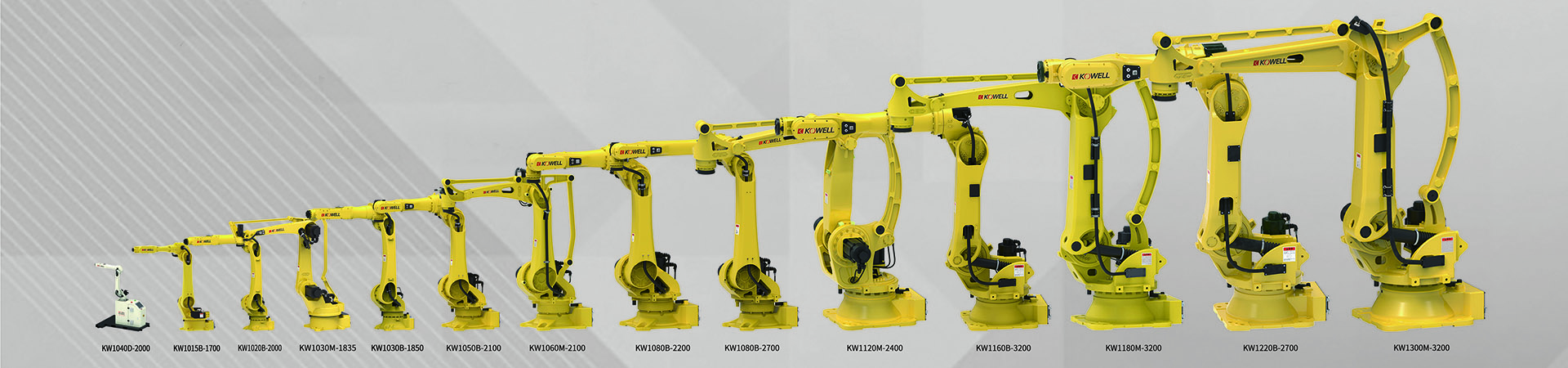
In CNC machining, stamping, injection molding, and other manufacturing applications, loading, unloading, and workpiece transfer are often repetitive, high-frequency tasks. Manual handling can be affected by operator fatigue and production cycles, while fixed automation may lack flexibility when production involves multiple products or small batches.
Kowell’s Six-Axis Loading and Unloading Robot combines multi-axis movement, high repeatability, and stable operation to automate loading and unloading across different manufacturing processes. The robot can also be integrated with existing equipment and production systems to support a more flexible automated workflow.
Greater Flexibility with Six-Axis Movement
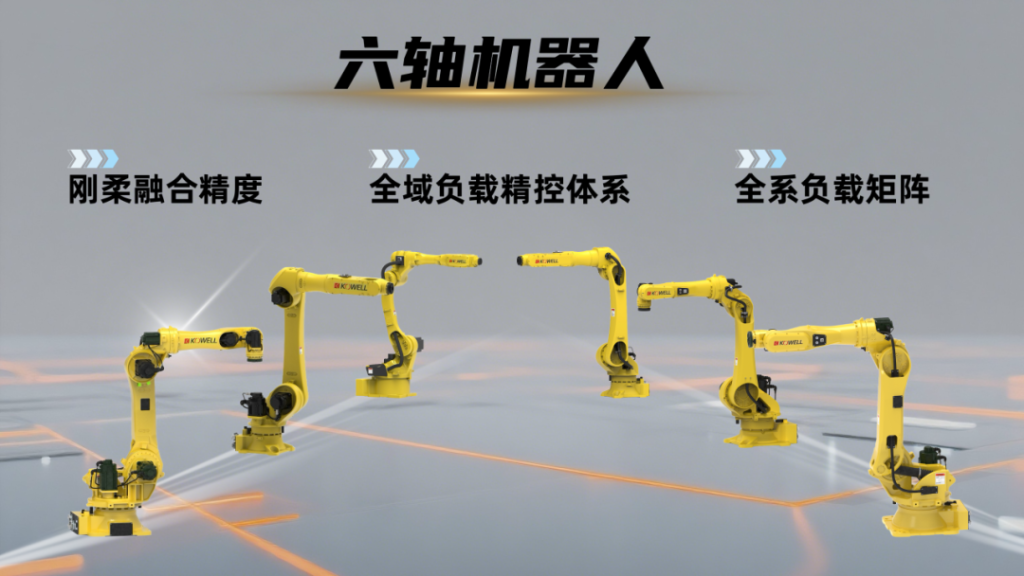
Kowell six-axis loading and unloading robots feature a rigid robot body and RV reducers, supporting stable operation in high-speed, repetitive, and relatively heavy-duty applications.
The six-axis configuration allows the robot to adjust its orientation according to the position of the workpiece and machine. It can perform turning, rotating, and picking and placing from different directions.
This flexibility is particularly useful for compact workstations, machines installed at different angles, or applications involving irregularly shaped workpieces. In addition to basic pick-and-place operations, the robot can also handle workpiece transfer between different processes.
Suitable for Different Manufacturing Applications
A six-axis loading and unloading robot can be configured according to different machines and production processes.
For CNC machine tending, it can handle raw material picking, machine loading, finished-part unloading, and transfer between processes. In stamping applications, it can perform part picking and placing according to the production cycle. In injection molding, it can be used for part removal, transfer, and handoff to subsequent processes.
For industrial environments involving cutting fluid, metal dust, or oil, an appropriate robot protection level can be selected according to the application. Kowell robots can operate continuously in ambient temperatures from 0–45°C.
Flexible for Multi-Product Production
Changes in product specifications are common in automated manufacturing. The six-axis loading and unloading robot can use different programs for different workpieces and adjust parameters such as workpiece dimensions, gripping positions, machine positions, and movement paths.
For multi-product production, dedicated programs can be created for different workpieces and recalled when products are changed, reducing repeated setup work.
The robot can also work together with grippers, machine tools, and conveyors to build an automated loading and unloading workstation around the actual production process, allowing manufacturers to upgrade automation while keeping their existing core equipment.
Integrating with Existing Equipment
In practical applications, a loading and unloading robot needs to communicate with CNC machines, stamping equipment, injection molding machines, conveyors, inspection equipment, PLCs, and other production systems.
Kowell six-axis loading and unloading robots support common communication methods such as I/O, PROFINET, and Modbus, allowing integration with different machines and control systems according to project requirements.
For example, after a machine completes its machining cycle and sends a signal, the robot can automatically perform the unloading operation. It can then proceed with the next loading cycle according to the machine status.
Through signal exchange between different devices, the loading and unloading process can be coordinated with upstream and downstream operations, reducing manual intervention and improving production continuity.
From Automated Handling to Process Optimization
For repetitive and high-frequency loading and unloading tasks, a robot can continuously perform predefined operations. For multi-station, multi-angle, and multi-product production, the six-axis configuration provides greater flexibility.
By integrating the robot with existing machines, fixtures, and control systems, manufacturers can build automated workstations according to their actual production requirements. This can reduce repetitive manual work while maintaining production flexibility.
For manufacturers looking to improve loading and unloading consistency, reduce manual intervention, and gradually introduce automation, a Six-Axis Loading and Unloading Robot can serve as an important link between processing equipment and automated production.
FAQ
Q1: What equipment and production processes can a six-axis loading and unloading robot be used for?
A six-axis loading and unloading robot can be used with CNC machines, stamping equipment, injection molding machines, and other equipment for automated loading and unloading. It can also handle workpiece transfer, inter-process handling, and pick-and-place operations.
Its six-axis movement capability allows it to approach workpieces from different directions and handle different loading and unloading orientations, making it suitable for repetitive operations and processes involving multiple workstations.
Q2: Does the robot need to be reprogrammed when workpiece sizes or shapes change?
The required adjustment depends on changes in workpiece dimensions, weight, gripping position, and production process. For different workpiece specifications, robot positions, orientations, and movement parameters can be adjusted to match the new task.
For multi-product production, separate programs can be created for different workpieces and recalled when products are changed, reducing repeated setup work.
Q3: Can a six-axis loading and unloading robot integrate with existing equipment and production lines?
Yes. Kowell six-axis loading and unloading robots support I/O, PROFINET, and Modbus and can be integrated with CNC machines, stamping equipment, injection molding machines, conveyors, inspection equipment, PLCs, and upper-level control systems.
The robot can respond to signals such as machine status, workpiece presence, and machining completion to automatically perform loading, unloading, and transfer operations. For existing production lines, integration can be adapted to the equipment interfaces and process requirements, reducing manual intervention.
Online Consultation
Hello, the current customer service is offline. You can leave your contact information and the staff will respond to you as soon as possible!