
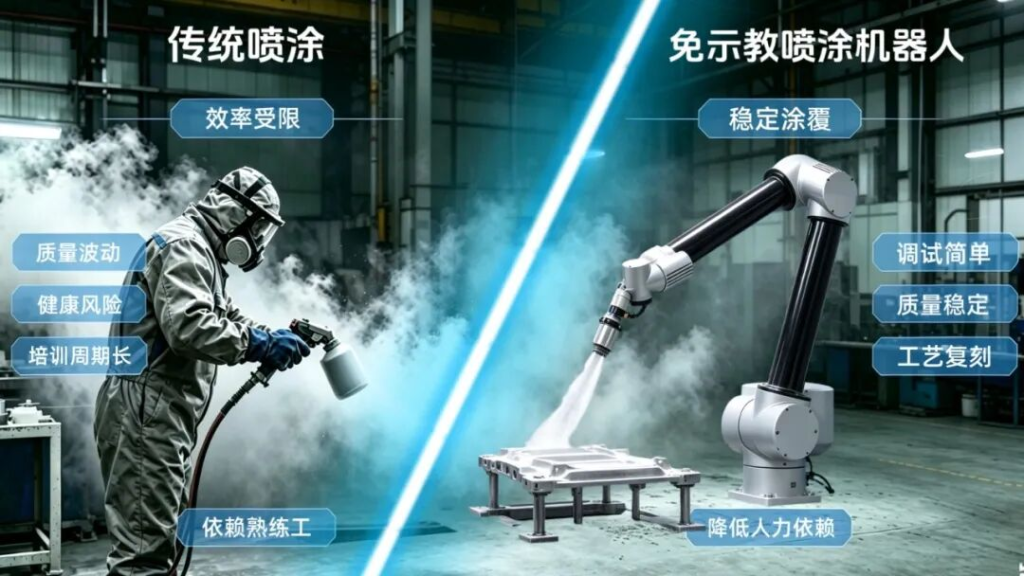
Traditional manual spray painting can be highly dependent on operator skill. Differences in spraying speed, distance, and movement can lead to inconsistent coating quality, while repetitive painting work can also increase labor pressure and exposure to paint mist.
At the same time, conventional robotic painting often requires experienced technicians to program and adjust spraying trajectories, making frequent product changes more time-consuming.
Kowell's Teaching-Free Painting Robot takes a different approach. Based on its independently developed motion control technology, the system allows operators to demonstrate a spraying path directly instead of programming the robot point by point. This simplifies robot setup while helping maintain consistent spraying performance across repetitive operations.
Lowering the Operating Barrier and Improving Workplace Safety
One of the key advantages of a teaching-free painting system is its simplified operation.
Operators do not need extensive robot programming experience to create standard spraying paths. After basic training, they can use the handheld device to demonstrate the required movement, allowing the robot to generate the corresponding trajectory.
The system can also reduce the need for personnel to perform repetitive spraying operations directly in the painting area. By transferring repetitive painting tasks to the robot, manufacturers can reduce workers' exposure to paint mist and create a safer working environment.
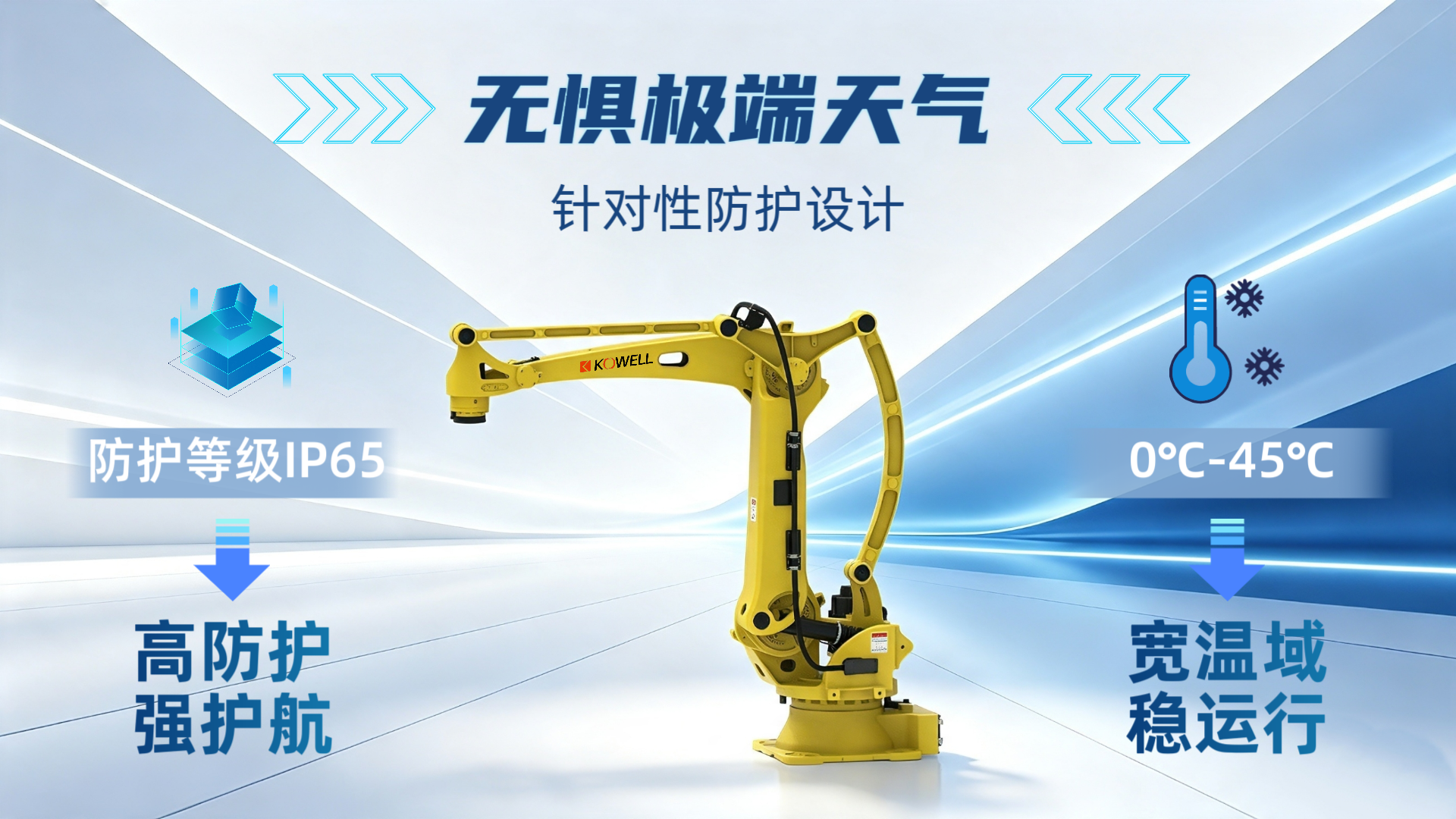
The robot features a compact structure that requires relatively little installation space. Its protective design is suitable for demanding painting environments where dust, paint mist, and other industrial contaminants may be present. The specific protection configuration can be selected according to the application requirements.
Reproducing Real Spraying Processes Without Point-by-Point Programming
Traditional robot programming often requires technicians to define and adjust multiple points along a spraying path. This can become inefficient when the production line handles different workpieces or frequently changes products.
The Teaching-Free Painting Robot simplifies this process.
Operators can hold the teaching device and demonstrate the desired spraying movement. The system captures the demonstrated motion and generates the corresponding robot trajectory, allowing the robot to reproduce the spraying path in subsequent operations.
This approach is particularly useful when the spraying path is difficult to define through conventional programming or when production involves frequent product changes.
Flexible for Different Workpieces and Production Requirements
Modern manufacturing increasingly involves multiple product models, different workpiece sizes, and smaller production batches. A painting automation system therefore needs to be more than simply repeatable—it also needs to be easy to adapt.
The Teaching-Free Painting Robot can be applied to different workpiece types, sizes, and spraying requirements. Potential applications include precision coating for 3C and electronic products, as well as painting processes for metal components, equipment enclosures, and construction machinery components.
The actual application depends on factors such as workpiece dimensions and weight, surface geometry, coating material, spray gun configuration, and required coating process.
Shorter Setup and Changeover Time
With conventional teaching-based programming, creating a new spraying trajectory may require technicians to spend considerable time programming and adjusting robot movements.
Teaching-free operation changes this workflow from point-by-point programming to direct path demonstration. For suitable applications, a new spraying path can be created by demonstrating the required movement and making the necessary parameter adjustments.
This can help shorten setup and changeover time, particularly on production lines handling multiple workpiece models and small batches.
Instead of relying entirely on specialized programming personnel for every product change, operators can handle routine path setup after appropriate training, while more complex applications can still be supported by professional engineers.
A Practical Approach to Flexible Painting Automation
Painting automation needs to address more than spraying speed. Ease of operation, coating consistency, worker safety, and the ability to respond to changing production requirements are equally important.
By combining direct path demonstration, simplified operation, motion control technology, and a compact industrial design, Kowell's Teaching-Free Painting Robot provides an alternative approach to conventional robotic painting programming.
For manufacturers looking to automate repetitive spray painting while maintaining flexibility for multi-product and small-batch production, teaching-free operation can make robotic painting easier to introduce and operate.
Frequently Asked Questions
Q1: Can operators without programming experience learn to operate the painting robot? How long does training take?
A: Yes. The Teaching-Free Painting Robot is designed to simplify routine operation. Instead of writing robot code or programming every point manually, operators can use the handheld teaching device to demonstrate the required spraying movement. The system then generates the corresponding robot trajectory based on the demonstrated path.
With basic training, operators without programming experience can learn essential operations and handle routine spraying tasks. For more complex applications, Kowell engineers can provide professional commissioning and technical support.
Q2: What routine maintenance does the painting robot require?
A: Routine maintenance is divided into basic operator checks and professional maintenance.
Operators can perform regular cleaning of the robot surface, inspection of emergency-stop functions, cables, and the end-of-arm tooling, as well as basic checks for abnormal joint operation and accumulated contaminants.
Periodic maintenance should include more detailed inspection and calibration of the robot, electrical connections, joints, and other key components. Maintenance intervals should be determined according to the operating environment, working hours, and application conditions.
Kowell can provide equipment maintenance documentation and technical guidance to help customers establish an appropriate maintenance routine.
Q3: How long is the delivery time, and how much production downtime is required for installation and commissioning?
A: For standard models, the typical delivery period is approximately 7–15 days, while customized configurations and complete line-integration projects generally require around 30–60 days, depending on the configuration and project scope.
For a standalone robot, installation and commissioning typically take around 1–3 days. When modifying an existing production line, installation work can be scheduled during planned downtime, such as night shifts or weekends, to minimize disruption to normal production.
Online Consultation
Hello, the current customer service is offline. You can leave your contact information and the staff will respond to you as soon as possible!