
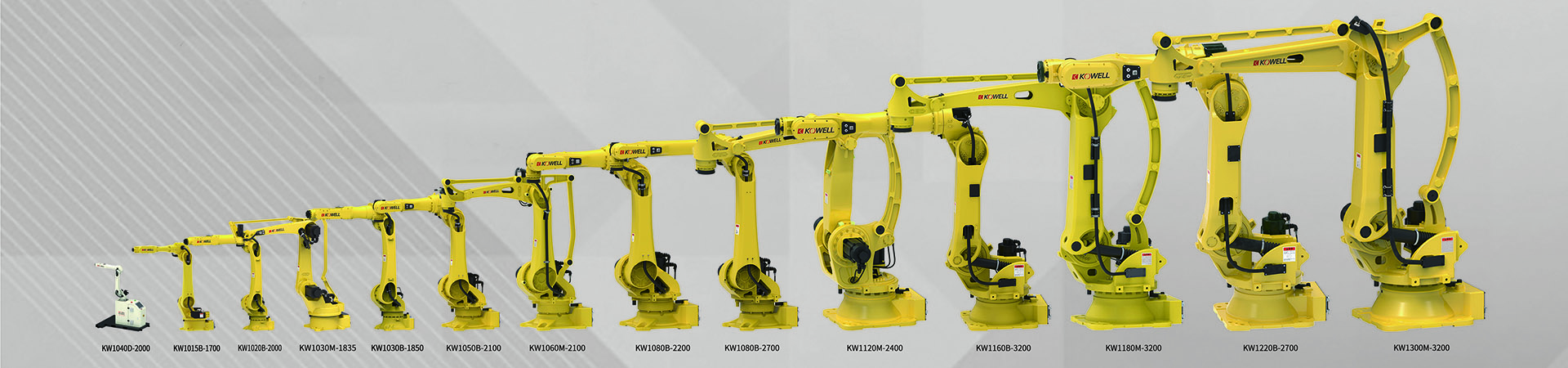
As manufacturers move toward more flexible production, end-of-line palletizing is facing new challenges. Traditional fixed palletizing systems can work efficiently in stable, high-volume production, but their fixed installation and limited flexibility can become a constraint when production involves multiple products, frequent changeovers, and smaller batches.
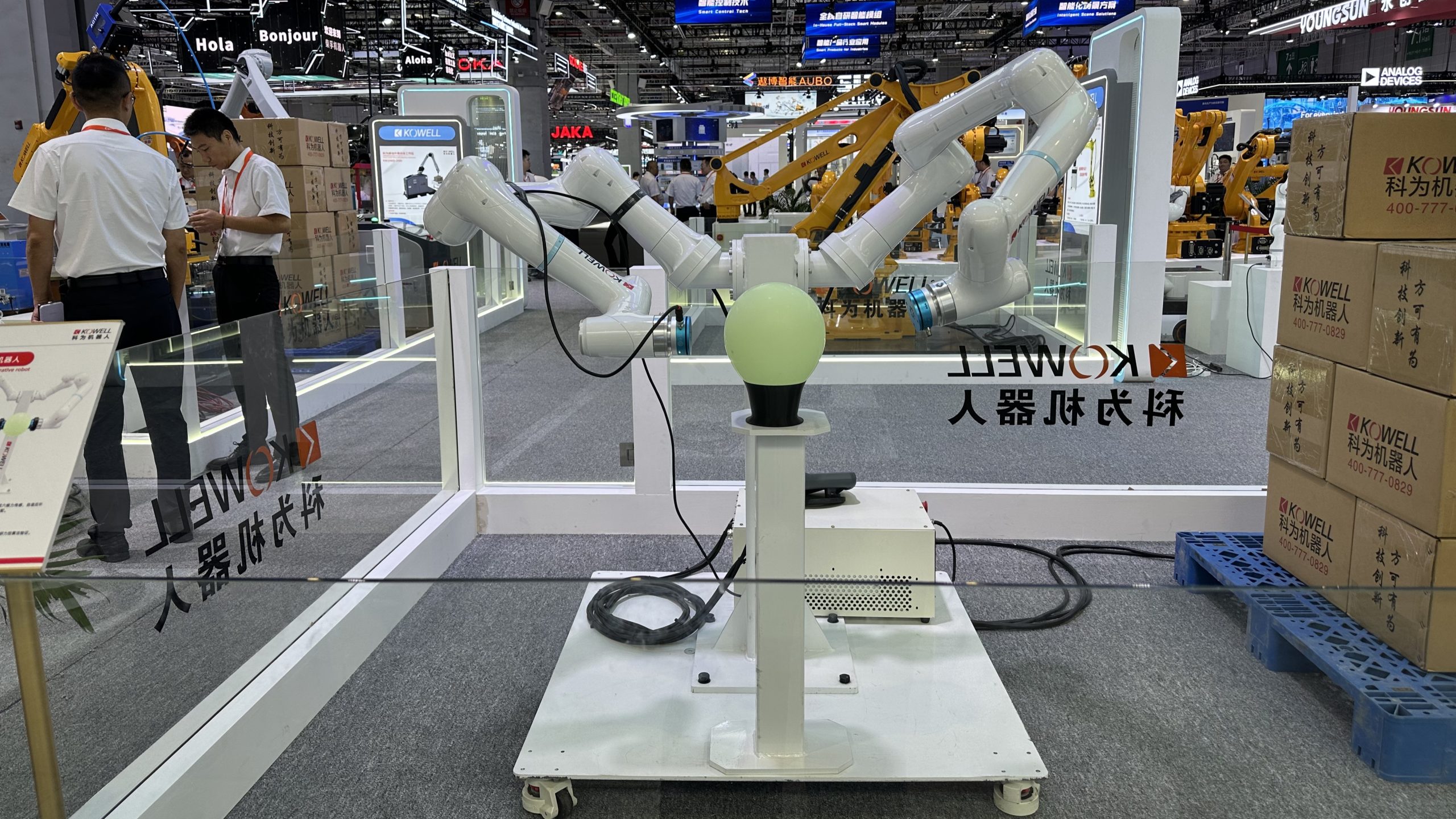
The KW1040D-2000 Mobile Collaborative Palletizing Robot from Kowell Robot takes a different approach. By combining collaborative robotics, palletizing capability, and mobile deployment, it provides manufacturers with a more flexible way to automate palletizing operations.
01. Mobile Collaboration: Breaking the Limits of Fixed Workstations
Traditional palletizing equipment is usually installed permanently at a dedicated workstation. When production layouts or product requirements change, relocating the equipment can require significant time, labor, and workshop modifications.
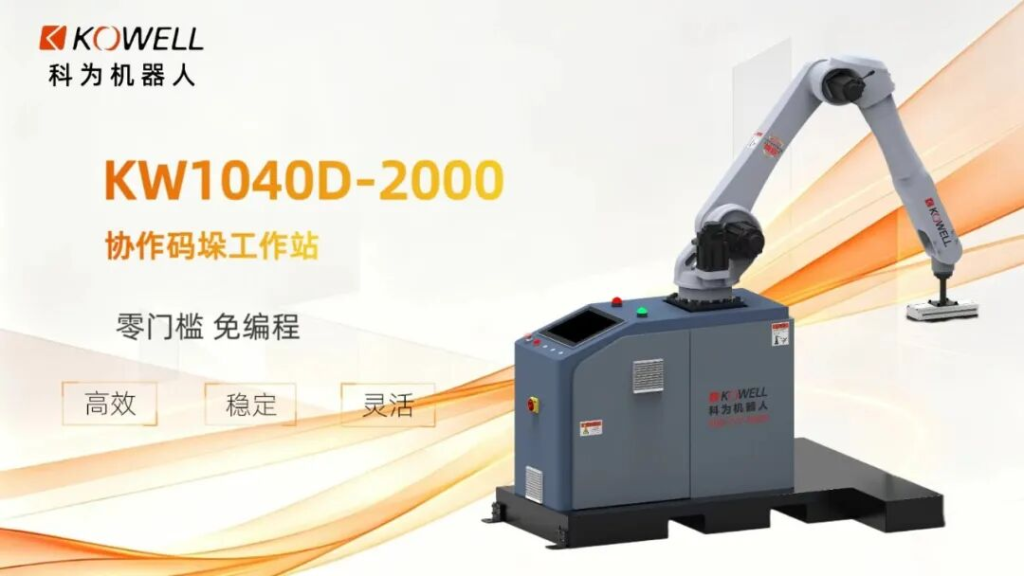
The KW1040D-2000 features a compact and lightweight structure. With a mobile base, the robot can be moved between different work areas according to production requirements.
This mobility allows manufacturers to adjust workstation layouts without major changes to the production floor. One robotic system can potentially serve different production areas, helping improve equipment utilization while supporting more flexible manufacturing.
02. 50 kg Payload and 2,000 mm Working Radius
The KW1040D-2000 is a six-axis collaborative robot designed for medium- and small-payload palletizing applications.
It provides a 50 kg wrist payload and a 2,000 mm working radius. When equipped with a lifting column, it can achieve a palletizing height of up to 2.5 meters.
The combination of payload, reach, and vertical flexibility allows the robot to handle a wide range of palletizing tasks. Compared with repetitive manual palletizing, robotic automation can provide more consistent operation while reducing physically demanding work for operators.
03. Safety Designed for Human-Robot Collaboration
Safety is an important consideration when introducing collaborative automation into production environments.
The KW1040D-2000 is equipped with a 10-level collision detection system designed to stop the robot when an unexpected collision is detected. It also provides 16 safety I/O interfaces with a redundant safety design to support integration with external safety devices and production equipment.
The robot's protective design also allows it to operate in industrial environments where dust and humidity may be present.
These safety features help create a more controlled working environment while allowing the Collaborative Palletizing Robot to work alongside production personnel in suitable applications following the required risk assessment and safety configuration.
04. From Robot Programming to Simple Parameter Configuration
For many manufacturers, the challenge of palletizing automation is not only the equipment itself, but also the technical skills required to operate and configure it.
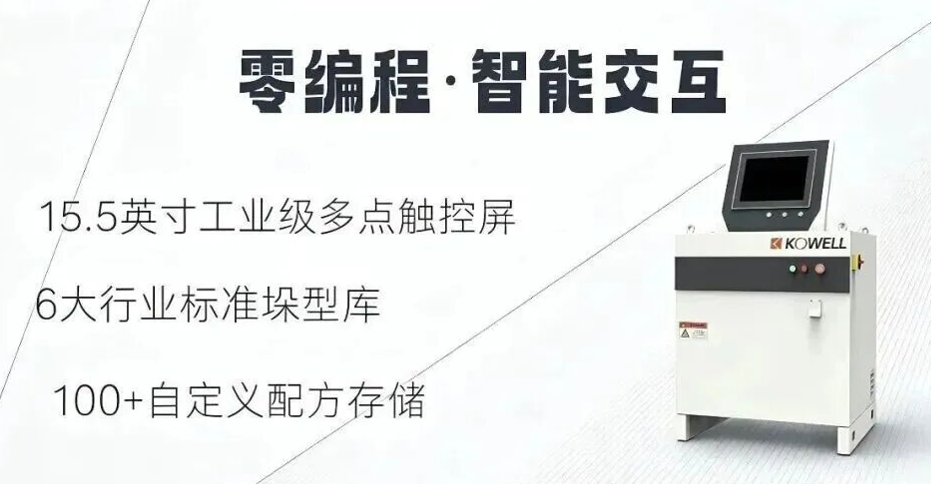
The KW1040D-2000 combines a handheld teach pendant with a graphical drag-and-drop interface and Kowell's self-developed palletizing process package. Operators can configure standard palletizing tasks by entering basic information such as pallet dimensions, product or carton dimensions, stacking layers, spacing, and palletizing patterns.
There is no need to memorize complex programming commands for standard palletizing applications. With basic training, operators without programming experience can learn essential operations such as teaching, start/stop, and simple program adjustments.
When product specifications or stacking patterns change, parameters can be adjusted directly through the interface. This allows the Mobile Collaborative Palletizing Robot to adapt to multi-SKU production, frequent changeovers, and small-batch manufacturing.
Flexible Automation for Changing Production Needs
Automation does not always mean installing one machine permanently for one task.
For manufacturers facing changing production requirements, a more flexible approach can be more valuable. By combining mobility, collaborative robot technology, palletizing capability, and simplified operation, the KW1040D-2000 provides a practical solution for flexible end-of-line automation.
The Mobile Collaborative Palletizing Robot is designed not only to automate repetitive palletizing work, but also to help manufacturers adapt automation resources to changing production needs.
As industrial automation continues to evolve, Kowell Robot will continue developing robotic systems that are easier to deploy, operate, and adapt to different production environments.
Frequently Asked Questions
Q1: Can operators with no programming experience learn to operate the robot? How long does training take?
A: Yes. The KW1040D-2000 combines a handheld teach pendant with a graphical drag-and-drop interface. Dedicated process templates for palletizing and material handling simplify robot setup. Operators can manually guide the robot to picking and placing points, save the positions, and configure parameters such as stacking layers, spacing, and operating speed.
With basic training, operators without programming experience can typically learn essential operations such as teaching, start/stop, and simple program adjustments within 1–2 days. For more complex applications, Kowell engineers can provide commissioning and technical support.
Q2: How easy is it to change product sizes, box dimensions, or palletizing patterns?
A: For products within the same category, operators can directly modify parameters such as product dimensions, quantity per layer, stacking pattern, and spacing through the graphical interface. Typical changeovers can be completed within 3–10 minutes, depending on the application.
For different product categories or changes in gripping methods, the corresponding end-of-arm tooling can be replaced and the required positions can be re-taught. This makes the system suitable for multi-SKU and small-batch production.
Q3: Can the robot integrate with existing conveyors, packaging machines, case sealers, and PLC systems?
A: Yes. The KW1040D-2000 supports common I/O communication, PROFINET, and Modbus, allowing it to communicate with conveyors, case sealers, inspection equipment, PLCs, and other production-line systems.
The robot can respond to incoming-product signals, stop when material is unavailable, and send full-pallet or other status signals to the production system. This enables coordinated operation across the end-of-line process and reduces the need for manual intervention.
Online Consultation
Hello, the current customer service is offline. You can leave your contact information and the staff will respond to you as soon as possible!