
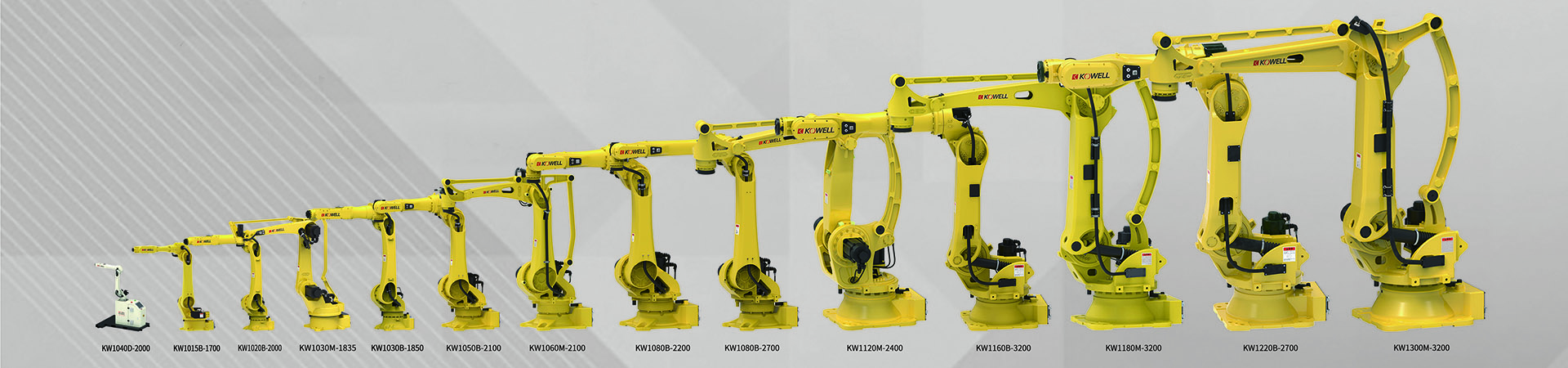
As multi-product and small-batch manufacturing becomes increasingly common, welding production faces challenges beyond simply improving welding speed. Manufacturers need equipment that can deliver stable welding quality, adapt to different workpieces and processes, and operate reliably over long production cycles.
For manufacturers, choosing an industrial welding robot is not simply about replacing manual welding. More importantly, it is about making the welding process more stable, repeatable, and adaptable to changing production requirements.
Shandong Kowell Robot focuses on robot bodies, motion control, and welding automation technologies, providing welding robot solutions for industries including steel structures, construction machinery, metal fabrication, and automotive components.
Rigidity: The Foundation of Stable Welding
Welding quality starts with the stability and precision of the robot itself.
Kowell industrial welding robots feature high-rigidity mechanical structures combined with high-precision servo drive systems to reduce vibration during high-speed movement and complex welding trajectories. With repeat positioning accuracy of up to ±0.05 mm, the robots can consistently execute linear, circular, and spatial welding paths.
For batch production, stable robot motion allows the same welding program to be repeatedly executed, reducing variations caused by manual operation and improving weld consistency.
From machining and assembly to final robot commissioning, Kowell follows standardized manufacturing and inspection procedures, with multiple tests and validations performed on the robot body and overall operation before delivery.
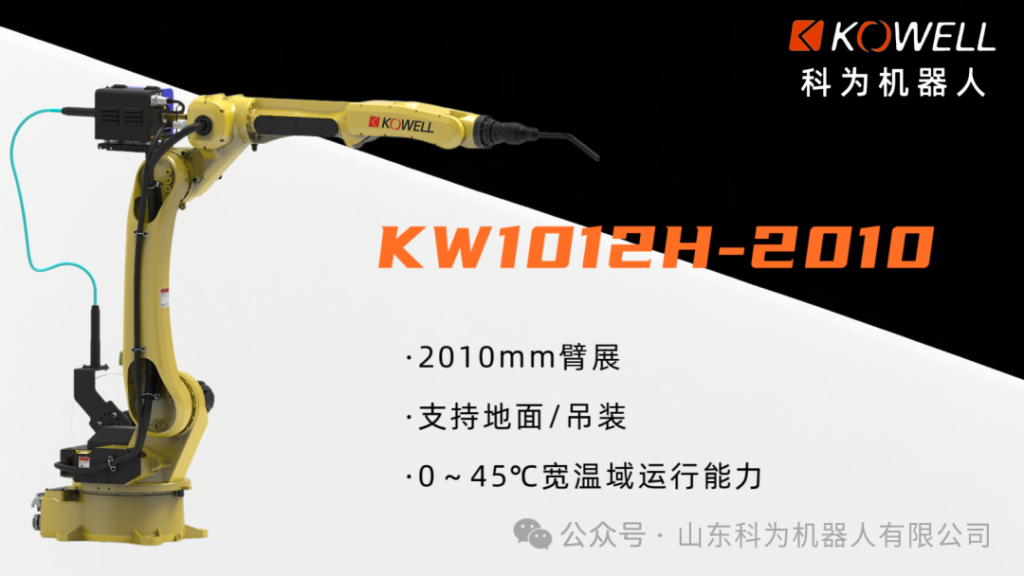
Welding workshops are also challenging environments for industrial equipment. Welding spatter, dust, heat, and other working conditions can affect equipment reliability. Kowell welding robots feature IP54 protection and a working temperature range of 0°C to 45°C, providing reliable support for continuous industrial welding operations.
Flexibility: Adapting to Different Workpieces and Welding Processes
If rigidity determines whether an industrial welding robot can operate stably, flexibility determines how many different production tasks it can handle.
Workpieces vary significantly in size, structure, and weld position. The robot therefore needs to be matched with the appropriate working radius, installation method, fixtures, and welding equipment according to the actual application.
Kowell welding robots can be configured for different installation requirements and combined with positioners and workholding fixtures to perform automated welding from different angles and positions.
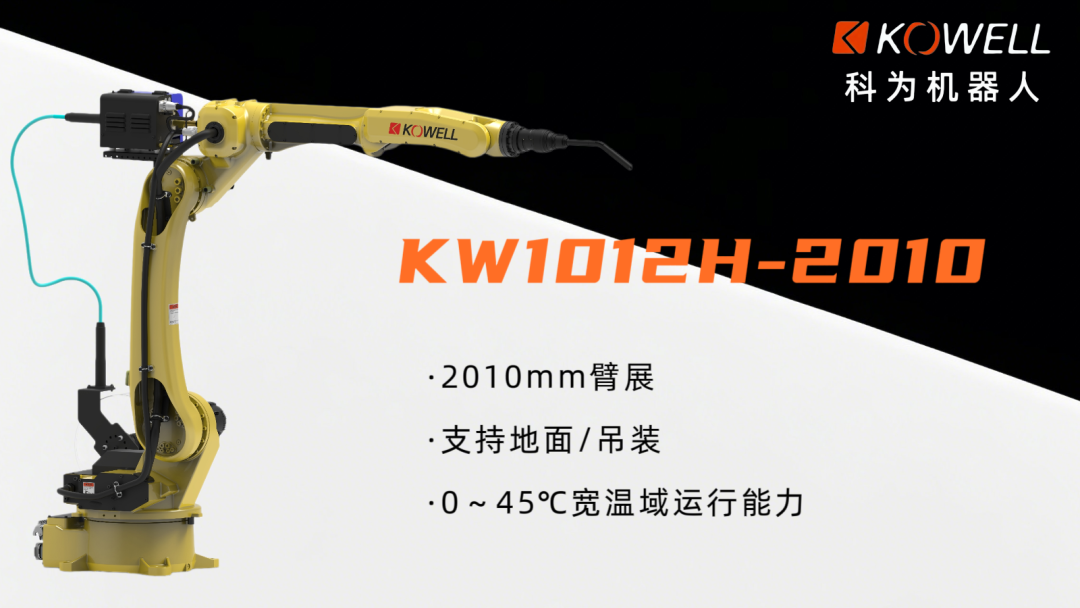
For example, the KW1012H-2010 provides a working radius of 2010 mm, covering a relatively large working area and supporting automated welding of various structural components and complex welds.
Depending on project requirements, the robot can also be integrated with different welding power sources, welding torches, and process equipment to support automated welding applications such as gas-shielded welding, TIG welding, and laser welding.
From steel structures and construction machinery components to metal frames, enclosures, pipes, and sheet metal parts, the appropriate robot and welding tooling can be selected according to the characteristics of each workpiece.
Efficiency: Making Welding Production More Consistent
Traditional manual welding relies heavily on the skills, experience, and working condition of individual welders. During long production runs or high-volume manufacturing, welding quality and production cycle times can be affected by human factors.
An industrial welding robot can repeatedly execute programmed welding paths and process parameters, helping maintain a more consistent production cycle during batch manufacturing.
By properly configuring welding current, voltage, travel speed, and weaving parameters, manufacturers can reduce process variations between operators, improve weld consistency, and potentially reduce rework and subsequent grinding.
The value of automated welding is therefore not simply about reducing manual labor. More importantly, it helps establish a more stable and repeatable production process, allowing workers to focus more on process management, quality control, and other tasks.
Finding the Right Welding Solution for Different Workpieces
Industrial welding robots are not limited to large steel structures.
For small workpieces with standardized shapes and high production volumes, fixed welding workstations can be used to improve equipment utilization and production efficiency.
For large structural components, long workpieces, or products with complex welding positions, six-axis welding robots can be combined with positioners and dedicated fixtures to achieve multi-angle and multi-position automated welding.
Therefore, selecting an industrial welding robot should involve more than simply looking at robot payload. Workpiece dimensions, weight, number and position of welds, production cycle time, and production volume should all be considered.
Kowell can configure robot bodies, welding power sources, welding torches, positioners, fixtures, and related auxiliary equipment according to different application requirements, helping integrate welding robots into existing production lines.
More Than a Robot: Building a Complete Automated Welding Cell
A robot is only the core execution unit of an automated welding system.
A reliable automated welding process also requires coordinated operation between the robot, welding system, fixtures, positioners, and safety equipment.
Kowell continues to develop supporting capabilities for industrial welding applications and can combine different equipment according to workpiece and production requirements, helping manufacturers move from a single robot to a more complete automated welding cell.
For common welding workshop conditions such as welding fumes, arc radiation, and spatter, optional equipment such as welding safety enclosures, fume extraction systems, light barriers, and safety light curtains can be configured according to site requirements.
Additional protection can also be applied to robot cables and related components when operating in high-temperature and high-spatter welding environments, improving long-term equipment reliability.
From a stable robot body and flexible welding processes to complete automation support, Kowell aims to solve not only the question of whether a robot can weld, but also how automated welding can operate reliably over the long term.
Rigidity provides the foundation for welding quality.
Flexibility allows the robot to handle more workpieces.
Efficiency turns automation into real production value.
Kowell will continue to develop industrial welding robots and automation technologies, optimizing robot bodies, motion control, and welding processes for different manufacturing applications.
With reliable equipment and flexible automation solutions, Kowell helps manufacturers move toward more stable, efficient, and scalable welding automation.
Frequently Asked Questions
Q1: What types of workpieces are suitable for welding robots? Can they handle both steel structures and small metal parts?
A: Yes. Different welding robot solutions can be configured according to workpiece dimensions, weld types, and production requirements. Applications include steel structures, construction machinery components, metal frames, enclosures, pipes, and sheet metal parts.
For standardized small parts produced in batches, fixed welding workstations can be used. For larger or more complex workpieces, six-axis welding robots can be combined with positioners and fixtures for multi-angle and multi-position welding.
Q2: Can operators without robot programming experience operate a welding robot? Is the welding quality consistent?
A: Yes. Welding robots are equipped with a teach pendant and user-friendly operating methods. After training, operators can perform basic operations such as starting and stopping the equipment, adjusting basic parameters, and teaching simple welding paths. Complex welding processes and system commissioning can be handled by professional engineers according to the actual workpiece and welding requirements.
During batch production, welding programs and process parameters can be repeatedly executed, helping reduce variations caused by manual operation and improving weld consistency and production stability.
Q3: Welding workshops generate a lot of fumes and spatter. Are protection solutions available?
A: Yes. Depending on site conditions and safety requirements, the system can be equipped with welding safety enclosures, fume extraction systems, light barriers, and other safety equipment to help isolate arc radiation and welding fumes.
For high-temperature and high-spatter environments, additional protection can also be configured for robot cables, the robot body, and related equipment to improve reliability during long-term welding operations.
Online Consultation
Hello, the current customer service is offline. You can leave your contact information and the staff will respond to you as soon as possible!