
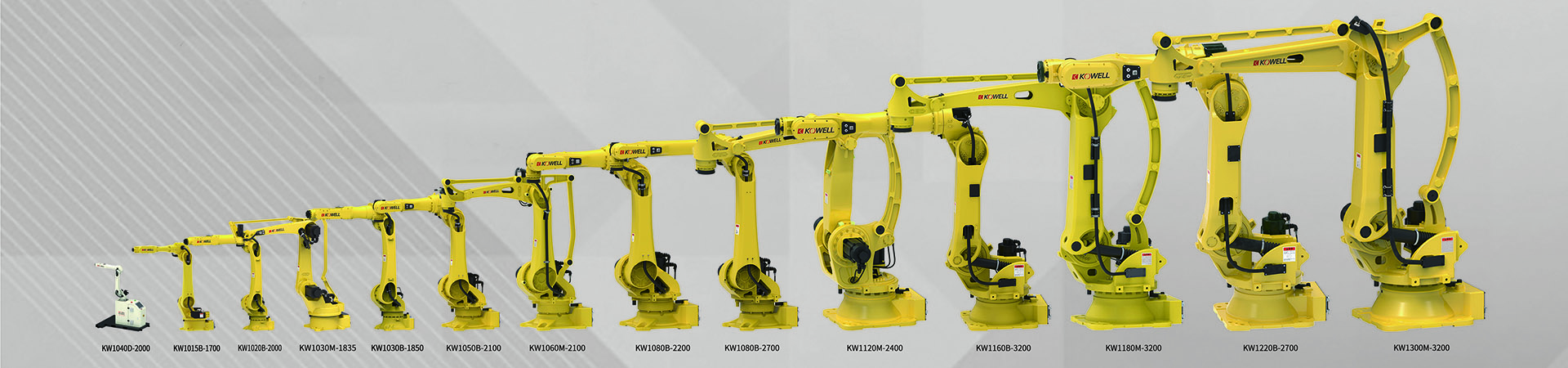
As multi-SKU and small-batch manufacturing become increasingly common, many companies are facing new challenges in their palletizing operations. Traditional automation systems often require complex programming and lengthy changeovers, while manual palletizing struggles with labor shortages, inconsistent efficiency, and rising operating costs. For manufacturers with limited floor space and frequent product changes, achieving flexible and efficient palletizing automation has become a key priority.
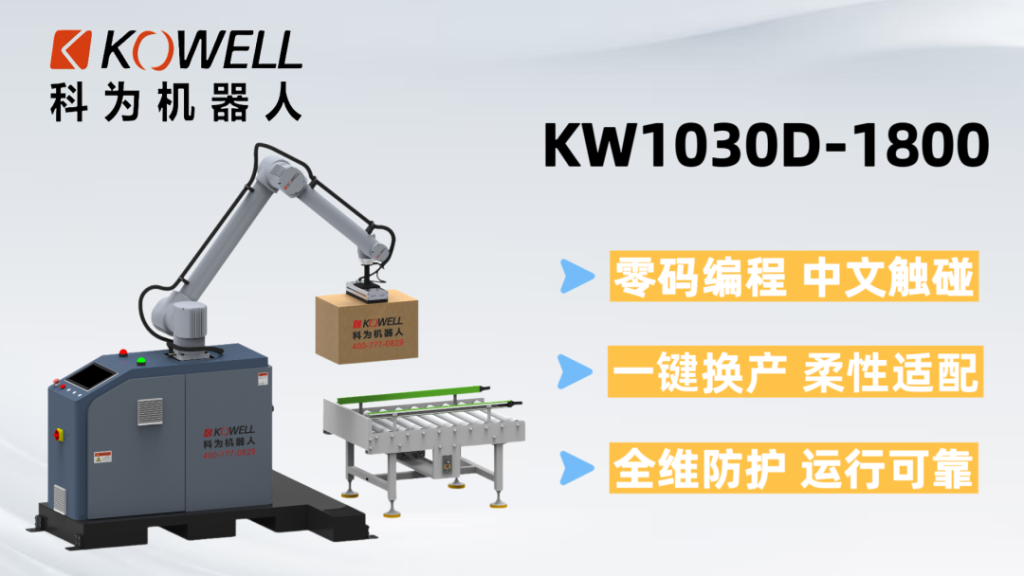
To address these challenges, Kewei Robot has developed the KW1030D-1800 and KW1040D-2000 Collaborative Palletizing Workstations. Combining easy operation, flexible deployment, and reliable safety features, these solutions help manufacturers improve palletizing efficiency while reducing dependence on manual labor.
Two Models for Different Production Requirements
KW1030D-1800 Collaborative Palletizing Workstation
- Payload: 30 kg
- Working Radius: 1800 mm
- Palletizing Height: Up to 2.1 m
Designed for lightweight cartons and bagged products, this model features a compact footprint and is well suited for production lines with limited installation space.
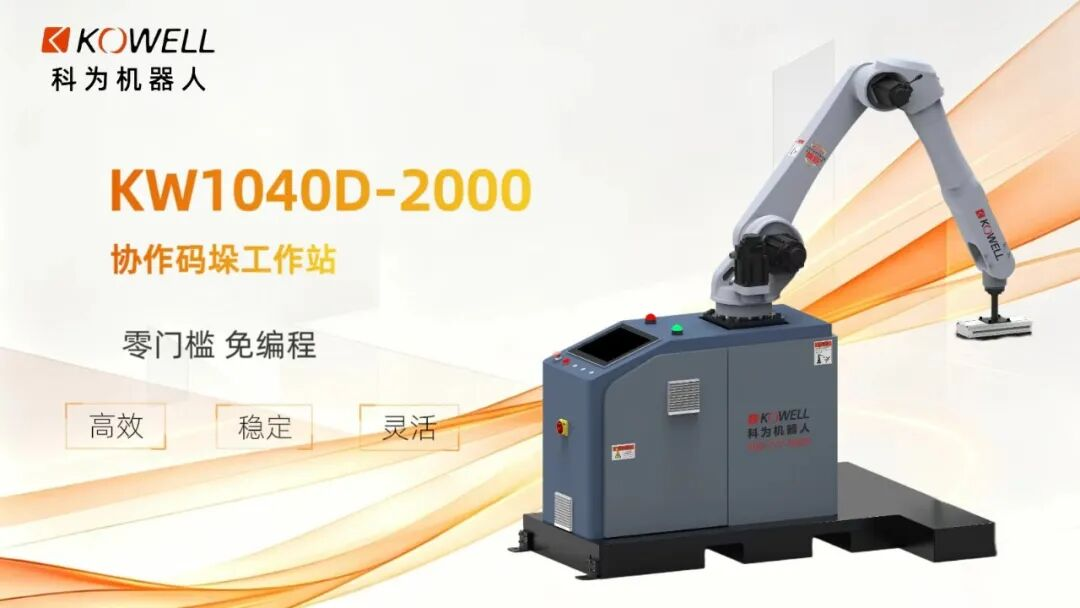
KW1040D-2000 Collaborative Palletizing Workstation
- Payload: 50 kg
- Working Radius: 2000 mm
- Palletizing Height: Up to 2.5 m with lifting column
This model is ideal for medium-weight products and higher stacking requirements, offering a larger working range and greater application flexibility.
Simple Operation with No Complex Programming
One of the biggest barriers to automation is the need for specialized programming skills. The Collaborative Palletizing Workstation addresses this challenge through an intuitive graphical operating system developed by Kewei.
The system features a fully visual touchscreen interface with drag-and-drop task configuration. Operators can quickly set pallet dimensions, carton sizes, and pallet patterns without writing code.
Built-in palletizing templates and industry-specific process packages simplify setup even further. A 3D pallet pattern preview function allows users to visualize pallet layouts before production starts, improving setup efficiency and reducing operational errors.
After basic training, production staff can independently perform parameter adjustments, pallet pattern modifications, and routine operation tasks.
Reliable Safety and Environmental Protection
Multiple Safety Protection Functions
The workstation is equipped with 16 safety I/O interfaces, ensuring that critical safety functions remain effective even if a single safety circuit experiences a fault.
IP54 Protection Rating
With an IP54 protection rating, the system can operate reliably in environments with dust, moisture, and other common industrial conditions, making it suitable for food processing, packaging, daily chemical products, and similar industries.
Designed for Human-Robot Collaboration
The collaborative design allows safer interaction between operators and automation equipment, making the workstation suitable for production environments that require frequent operator involvement.
Compact Design for Easy Integration
Compared with traditional palletizing systems, the Collaborative Palletizing Workstation features an integrated design with a smaller footprint and easier installation.
The workstation can be deployed at the end of existing production lines or in space-constrained areas without requiring major factory modifications. This helps reduce installation costs and minimize production downtime.
In addition, its mobile deployment capability allows manufacturers to relocate the system when production requirements change, maximizing equipment utilization and production flexibility.
Supporting the Future of Flexible Manufacturing
Automation is no longer limited to large-scale factories. Today, manufacturers of all sizes are seeking practical solutions that improve efficiency, reduce labor dependence, and increase production stability.
The KW1030D-1800 and KW1040D-2000 Collaborative Palletizing Workstations provide a balance of flexibility, ease of use, safety, and performance. By simplifying palletizing automation, they help manufacturers upgrade production processes while maintaining operational efficiency and flexibility.
As industrial automation continues to evolve, Kewei Robot remains committed to developing reliable and user-friendly palletizing solutions that support smarter manufacturing.
Frequently Asked Questions (FAQ)
Q1: Does installation require a concrete foundation? Can the workstation be installed directly on an existing factory floor?
A: Most small and medium-sized collaborative palletizing workstations do not require a dedicated concrete foundation. As long as the floor is level and meets load-bearing requirements, the system can be installed directly on a standard factory floor. Thanks to its compact footprint, it can be deployed at the end of production lines or in space-limited work areas. For higher-payload models, Kewei provides floor load recommendations based on equipment weight and operating conditions. In most cases, existing facilities can be upgraded without extensive civil construction work.
Q2: Is it difficult to change carton sizes, product specifications, or pallet patterns? How long does changeover take?
A: For products within the same category, operators can modify carton dimensions, stacking layers, and pallet patterns directly through the operating interface. Most adjustments can be completed within 3–10 minutes. When changing product categories or switching gripping methods, only simple reteaching is required after replacing the end-of-arm tooling. This significantly improves changeover efficiency and makes the workstation ideal for multi-SKU flexible production environments.
Q3: Can the robot be integrated with existing conveyors, packaging machines, case sealers, and PLC systems?
A: Yes. The system supports mainstream industrial communication protocols, including I/O, Profinet, and Modbus. It can be seamlessly integrated with conveyors, packaging equipment, case sealers, inspection systems, PLC controllers, and factory management platforms. Functions such as automatic product detection, material shortage alerts, and full-pallet notifications can be implemented to help manufacturers achieve a more automated and efficient production workflow.
Online Consultation
Hello, the current customer service is offline. You can leave your contact information and the staff will respond to you as soon as possible!