
As manufacturing continues to accelerate toward intelligent and automated production, the limitations of traditional manual welding are becoming increasingly evident. Low production efficiency, inconsistent weld quality, a shortage of skilled welders, and rising labor costs have become major challenges for manufacturers seeking to expand production and improve competitiveness.
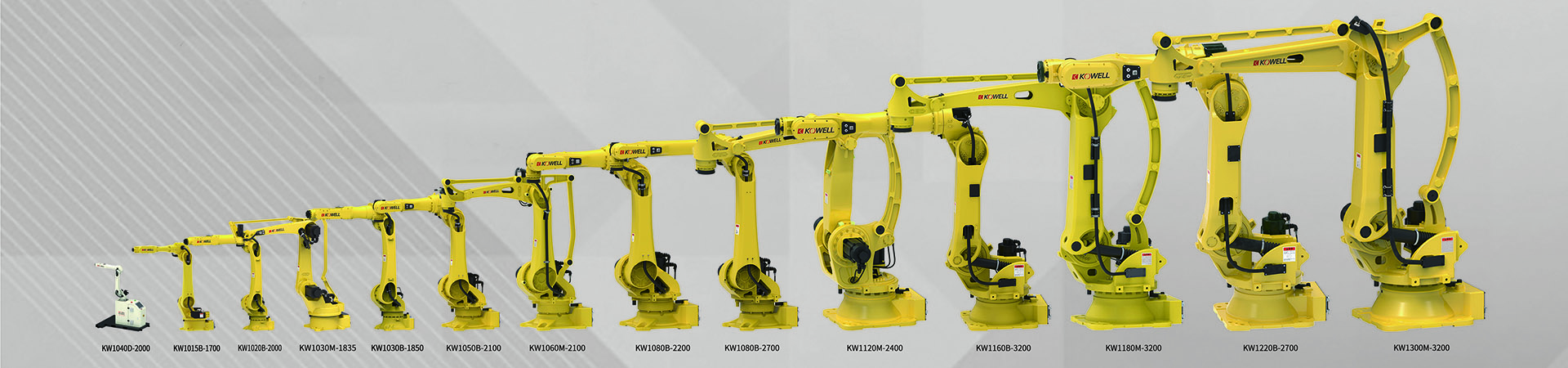
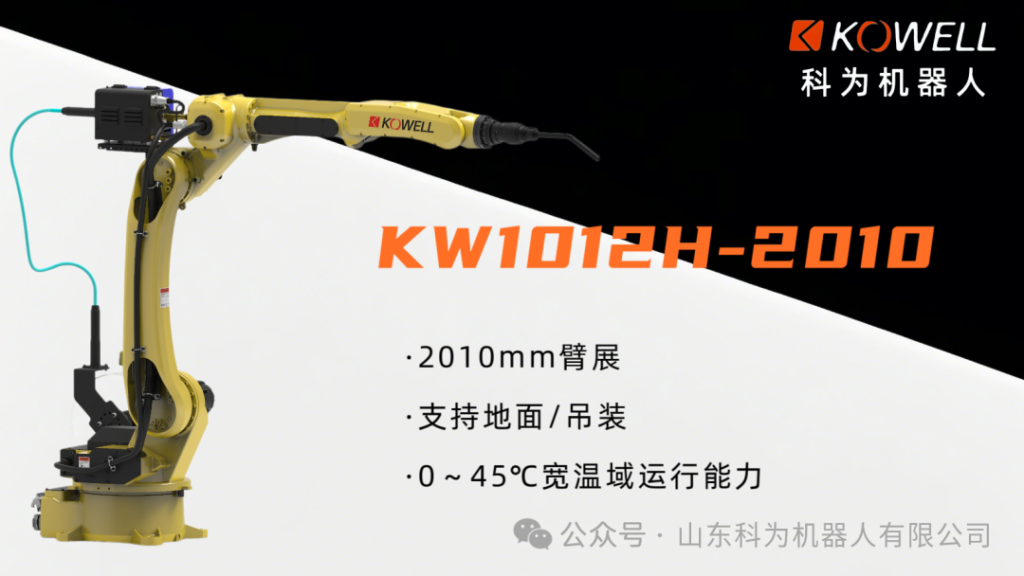
With years of experience in industrial automation and robot manufacturing, Shandong Kewei has developed two welding robot models, the KW1010H-1440 and KW1012H-2010. Combining high-performance mechanical design with flexible application capabilities, these welding robots help manufacturers improve welding quality, increase production efficiency, reduce labor costs, and achieve more stable production.
Expanded Working Range: More Flexible Production Line Layouts
1. Wide Coverage for Complex Welding Applications
With an extended arm reach, the welding robot can cover large structural components and complex curved surfaces, helping eliminate common limitations caused by restricted working ranges.
From heavy engineering machinery components to curved weld seams in vehicle and ship manufacturing, the robot can handle a wide range of welding applications with greater flexibility.
2. Flexible Installation Options
Both the KW1010H-1440 and KW1012H-2010 support floor-mounted and overhead installation configurations, allowing manufacturers to select a suitable installation method according to their production line layout.
Whether the production area is compact or the existing line requires a customized layout, the welding robot can be integrated into different manufacturing environments with greater flexibility.
3. Compact Design for Better Space Utilization
The compact robot body provides a wide working range while reducing the space required for installation. This makes it easier for manufacturers to optimize production line layouts and improve overall space utilization during automation upgrades.
Precision Control: Consistent Welding Performance
1. High-Rigidity Structure for Stable Operation
The welding robot features a high-rigidity body structure and optimized joint design to effectively reduce deformation during robot movement.
During high-speed operation and continuous welding, the rigid mechanical structure helps maintain stable movement and reduce positioning deviations, providing a reliable foundation for consistent welding quality.
2. Repeatability of ±0.05 mm
With repeatability of up to ±0.05 mm, the welding robot can accurately reproduce complex straight lines, arcs, and spatial curves.
This helps achieve more uniform weld seams and consistent welding results, reducing quality variations commonly associated with manual welding operations.
3. High-Precision Servo Drive System
The high-precision servo drive system enables the robot to achieve a balance between welding speed and trajectory accuracy.
By maintaining precise movement along complex welding paths, the robot can handle demanding applications such as curved and multi-directional welding while improving overall production consistency.
Flexible Welding Capabilities for Different Applications
1. Compatible with Multiple Welding Processes
The welding robots are compatible with mainstream welding processes, including MIG/MAG welding, laser welding, and TIG welding.
They can be used for welding materials such as carbon steel and stainless steel, allowing manufacturers to handle different welding processes and material requirements with greater flexibility.
2. Stable Operation in Demanding Industrial Environments
Designed for demanding industrial applications, the robot features a high level of protection against common environmental challenges such as welding spatter and dust.
With a working temperature range of 0°C to 45°C, the welding robot can operate reliably in a variety of industrial environments, including heavy machinery and vehicle or ship manufacturing applications.
Welding Robots for More Efficient Manufacturing
A welding robot is more than an automated replacement for manual welding. It combines mechanical stability, precise motion control, and flexible application capabilities to help manufacturers improve welding consistency and production efficiency.
From heavy structural components to complex curved weld seams, the KW1010H-1440 and KW1012H-2010 provide flexible options for manufacturers looking to upgrade their welding operations.
Looking ahead, Shandong Kewei will continue to focus on industrial robot technology and intelligent manufacturing. Through ongoing product development, algorithm optimization, and application-focused innovation, Kewei aims to help manufacturers improve production efficiency and accelerate the transition toward smarter and more automated manufacturing.
Frequently Asked Questions About Welding Robots
Q1: What types of workpieces are suitable for welding robots? Can they be used for both steel structures and small metal parts?
A: Kewei welding robots can be used for a wide range of workpieces, including steel structures, engineering machinery components, metal frames, boxes, pipes, and sheet metal parts.
Different welding automation configurations can be selected according to the application. Fixed welding workstations are suitable for small and medium-sized batch production of regular workpieces, while mobile welding robots are better suited for large or long components and applications with changing working conditions. Welding positioners and customized fixtures can also be integrated to support multi-angle welding and improve production flexibility.
Q2: Can operators without professional welding or programming experience operate a welding robot? Is the welding quality consistent?
A: Yes. The welding robot is equipped with a teach pendant, allowing operators to manually guide the welding torch and record welding points to generate welding programs.
With basic training, operators can learn the fundamental operations within 1–2 days. Welding parameters such as current, voltage, travel speed, and weaving amplitude can be preset and standardized.
Compared with manual welding, robotic welding provides more consistent weld formation and penetration depth, helping reduce quality issues such as porosity, undercut, and excessive weld buildup. For batch production, welding robots can significantly improve weld consistency and repeatability.
Q3: Welding workshops often have heavy fumes and strong arc light. Are protective solutions available?
A: Yes. Kewei can provide optional safety and environmental protection solutions, including welding safety enclosures, fume extraction systems, protective light barriers, and safety light curtains to help isolate arc light and welding fumes.
The robot itself can also be equipped with protective coatings against welding spatter and heat-resistant cable protection sleeves. These solutions help the welding robot operate more reliably in high-temperature and high-spatter environments while extending equipment service life.
Online Consultation
Hello, the current customer service is offline. You can leave your contact information and the staff will respond to you as soon as possible!